


The Kailash Mansarovar Yatra via Nepal’s Simikot – Hilsa route is one of the most spiritually significant and increasingly popular pilgrimage journeys in Asia. Thousands of Indian and international devotees are making their way to the sacred Mount Kailash and Lake Mansarovar in Tibet through this Himalayan corridor – a route celebrated for its breathtaking landscapes, established infrastructure, and deep religious heritage.
Whether you are a devout Hindu seeking the blessings of Lord Shiva, a Buddhist tracing the footsteps of ancient masters, a Jain honoring Adinath, or a Bon practitioner circling the sacred mountain, this guide provides everything you need to plan your pilgrimage with confidence.
Why Choose the Simikot–Hilsa Route for Kailash Mansarovar Yatra?
The Simikot–Hilsa corridor through Nepal’s remote Humla District has emerged as one of the preferred gateways to Kailash Mansarovar, offering several advantages over alternative routes:
Relative Accessibility: The route is well-connected by domestic flights from Kathmandu to Nepalgunj, and onward to Simikot, making it reachable without lengthy overland travel.
Established Infrastructure: Simikot and the surrounding Humla region now feature guesthouses, helicopter services, logistics support, and experienced local guides – making the journey more manageable for pilgrims of varying fitness levels.
Scenic Himalayan Beauty: The route passes through some of Nepal’s most pristine high-altitude wilderness, offering views of snow-capped peaks, ancient villages, and remote river valleys.
Border Convenience: The Nepal–China border crossing at Hilsa (Nara La pass) leads directly into Tibet’s Purang (Taklakot) region, from where pilgrims continue toward Kailash and Mansarovar with relative ease.
The Sacred Sites: Mount Kailash and Lake Mansarovar
Mount Kailash (6,638 m / 21,778 ft)
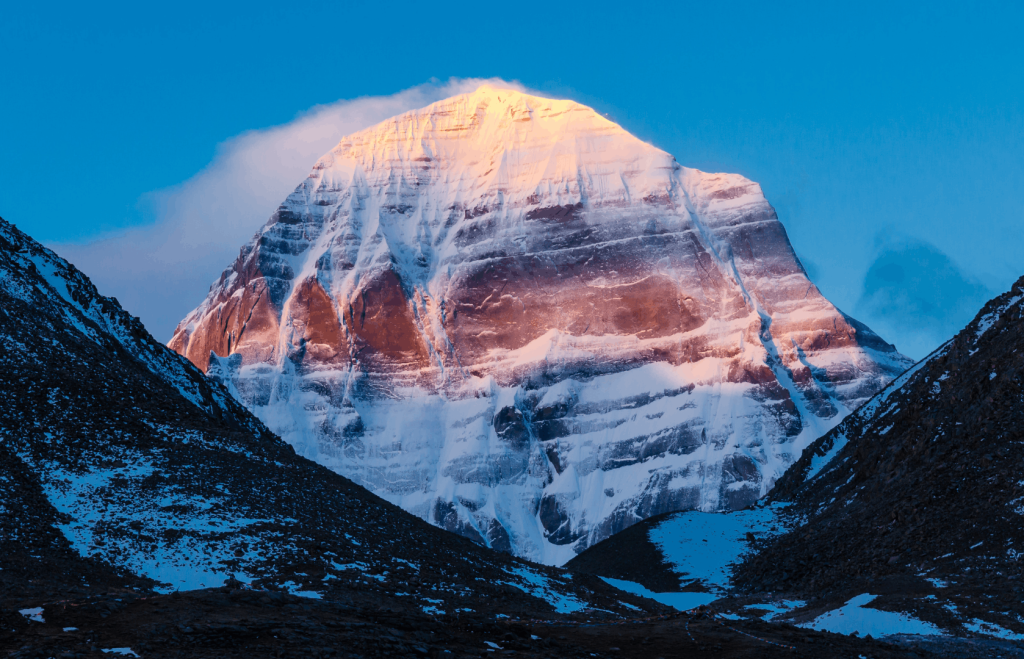
Mount Kailash, known in Sanskrit as Kailāsa Parvata and in Tibetan as Gangs Rinpoche (“Precious Snow Mountain”), stands in the remote Trans-Himalayan region of Western Tibet, in what is today the Ngari Prefecture of the Tibet Autonomous Region of China.
Religious Significance:
- For Hindus: Kailash is regarded as the earthly abode of Lord Shiva and his consort Parvati. It is one of the most sacred destinations in Hinduism. Circumambulating (pradakshina) the mountain – known as the Kailash Parikrama or Kailash Kora – is believed to cleanse the sins of a lifetime. The 52-km circuit is typically completed over three days.
- For Tibetan Buddhists: Kailash is considered the home of Demchok (Chakrasamvara), a tantric deity representing supreme bliss. It is also associated with the historical figure of Milarepa, the great Buddhist saint. Completing 108 koras around Kailash is said to bring enlightenment.
- For Jains: The mountain is revered as Ashtapada, the site where Rishabhadeva (Adinath), the first Tirthankara, attained moksha (liberation).
- For Bon practitioners: Kailash, known as Tise, is the seat of the sky goddess Sipaimen and the most sacred site in the ancient Bon religion, which predates Buddhism in Tibet.
Geography: Mount Kailash is unique in that it has never been officially climbed, and climbing is forbidden out of respect for its sacred status. Its four faces are believed to align with the cardinal directions, and it is the source of four of Asia’s major rivers: the Indus, the Sutlej, the Brahmaputra (Yarlung Tsangpo), and the Karnali (a tributary of the Ganges).
Lake Mansarovar (Mapam Yumco)
Located at an altitude of approximately 4,590 meters (15,060 ft) above sea level, Lake Mansarovar – known in Tibetan as Mapam Yumco – is one of the highest freshwater lakes in the world and one of the holiest in Asia.
Religious Significance:
- In Hindu tradition, Mansarovar was created in the mind of Lord Brahma and is considered the purest of all lakes. Bathing in its sacred waters is believed to cleanse sins and help attain liberation. The name “Mansarovar” derives from the Sanskrit Manas (mind) and Sarovar (lake).
- In Buddhist belief, it is associated with the legend of Queen Maya, the mother of the Buddha, who is said to have bathed here before giving birth to Siddhartha Gautama.
- The lake is also revered in Bon tradition as a highly sacred body of water with immense spiritual power.
Geography: Mansarovar spans approximately 88 km in circumference and is known for its strikingly clear, turquoise-blue waters. It sits beside the smaller but also sacred Rakshas Tal (Ravana Hrad), which is saltwater and associated with the demon king Ravana in Hindu mythology. The contrast between the two lakes – one sacred, one demonic – is a striking feature of this otherworldly landscape.

Complete Route: Kathmandu to Kailash via Simikot – Hilsa
Stage 1: Kathmandu, Nepal
Kathmandu (1,400 m / 4,593 ft), the capital of Nepal, is the starting point for most Kailash Mansarovar pilgrims traveling via the Nepal route. Pilgrims typically spend 1-2 days here for acclimatization, obtaining necessary permits, and joining tour packages.
Key Things to Do in Kathmandu:
- Visit Pashupatinath Temple, the sacred Shiva temple on the banks of the Bagmati River – a fitting spiritual beginning to the Kailash pilgrimage.
- Explore Boudhanath Stupa, one of the largest Buddhist stupas in the world and a UNESCO World Heritage Site.
- Arrange Chinese Tibet Travel Permits, Group Visa, and Alien Travel Permit through registered Nepal tour operators (individual permits are not issued for Tibet).
Stage 2: Nepalgunj
From Kathmandu, pilgrims fly to Nepalgunj (150 m / 492 ft), a city in the Terai lowlands of far-western Nepal. It serves as the transit hub for flights to Simikot. Pilgrims typically overnight here before the morning flight to Simikot.
Stage 3: Simikot, Humla District
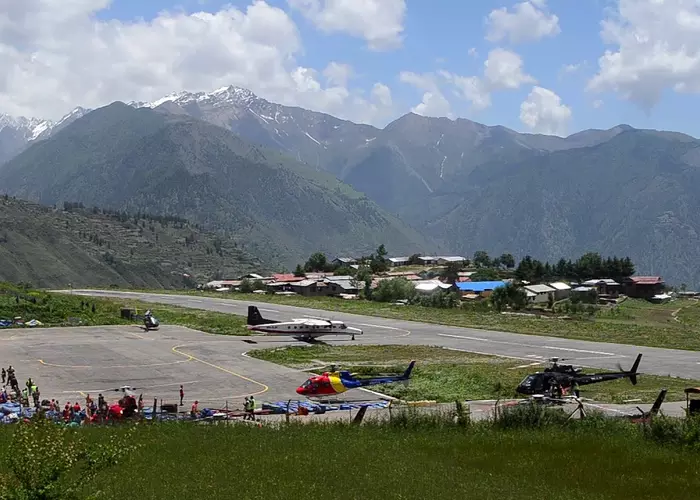
Simikot (2,910 m / 9,547 ft) is the district headquarters of Humla, Nepal’s most remote and least-developed district, located in the far northwestern corner of the country. It is accessible only by air – there are no roads connecting Simikot to the rest of Nepal’s road network.
About Simikot:
- Simikot Airport (IATA: IMK) is a high-altitude STOL (Short Take-Off and Landing) airstrip that handles small aircraft and helicopters.
- The town is home to a mix of Tibetan-influenced Himalayan communities, including the Kham, Sheshi, and other groups.
- The surrounding Humla region is known for its apple orchards, ancient gompas (Buddhist monasteries), and pristine wilderness.
- Local businesses including guesthouses, porters, and logistics providers serve the growing pilgrimage and trekking traffic.
Altitude Acclimatization: Pilgrims are advised to spend at least one night in Simikot to acclimatize before proceeding to higher elevations.
Stage 4: Hilsa (Nara La), Nepal–China Border
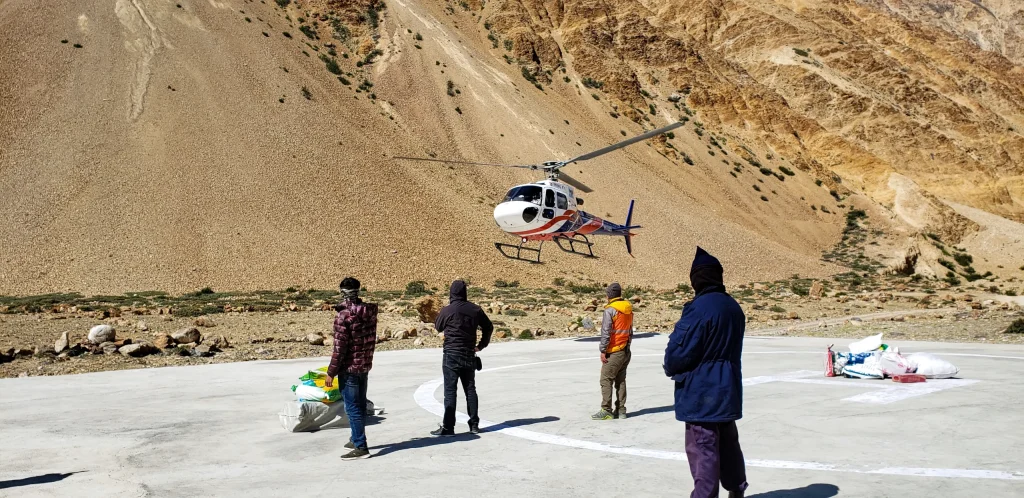
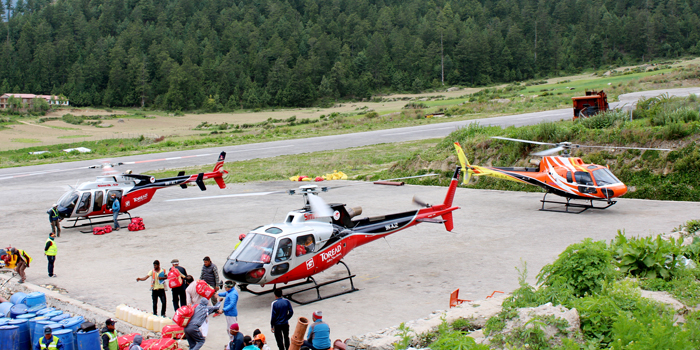
From Simikot, pilgrims travel to Hilsa (3,680 m / 12,073 ft) – either by helicopter (approximately 30 minutes) or by a multi-day overland/trekking route along the Karnali River valley. Hilsa is the last Nepali settlement before the border.
The Nepal–China border crossing here is via the Nara La pass, with the Chinese side called Sher or the Hilsa border post. Formalities are handled by tour operators who coordinate with Chinese authorities in advance.
Stage 5: Purang (Taklakot), Tibet
Crossing into Tibet, pilgrims arrive at Purang (3,900 m / 12,795 ft), known historically as Taklakot, in the Ngari Prefecture of the Tibet Autonomous Region. It is the first major Tibetan town on the route and serves as a resupply and acclimatization stop.
About Purang:
- Purang is one of the oldest continuously inhabited settlements in Western Tibet and has been a significant trade hub between Nepal and Tibet for centuries.
- The town is home to the ancient Korchag (Khojarnath) monastery and the nearby Simbiling monastery.
- It is the administrative gateway for pilgrims entering the Kailash–Mansarovar region.
Stage 6: Lake Mansarovar
From Purang, pilgrims travel approximately 100 km north to reach Lake Mansarovar, passing through high-altitude Tibetan plateau terrain. The drive typically takes 3–4 hours.
Pilgrims perform ritual bathing, prayer, and parikrama (circumambulation) of the lake. The full circuit of Mansarovar covers approximately 88 km and is often done over 2–3 days on foot or partially by vehicle.
Stage 7: Mount Kailash – The Kailash Kora (Parikrama)
The culmination of the pilgrimage is the Kailash Kora – the sacred circumambulation of Mount Kailash. The 52-km circuit is typically completed over 3 days:
Day 1: Yam Dwar (Gate of Death) to Dirapuk – passing the northern face of Kailash, with stunning views of the north face.
Day 2 (most demanding): Dirapuk to Zutulpuk, crossing the Drolma La Pass (5,630 m / 18,471 ft), the highest and most sacred point of the kora, believed to be the seat of the goddess Drolma (Tara). This day demands good physical fitness and acclimatization.
Day 3: Zutulpuk to Darchen – completing the circuit and descending to the base camp town of Darchen.

Pilgrimage Season: Best Time to Visit
The Kailash Mansarovar Yatra season generally runs from May to September, with peak months being June, July, and August.
| Month | Conditions |
| May | Early season; cooler, fewer crowds, some trail snow |
| June | Good weather; popular; warm days, cold nights |
| July | Peak season; warm; occasional monsoon rain at lower elevations |
| August | Peak season; stable at altitude; monsoon below |
| September | Excellent clarity; fewer pilgrims; cooling temperatures |
Avoid: October through April – Tibet closes to most pilgrims, routes are snow-covered, and extreme cold makes travel hazardous.
Auspicious Date (2026): The Saga Dawa Festival (celebrating Buddha’s birth, enlightenment, and parinirvana) in May/June is considered the most auspicious time for the Kailash Kora. Performing the kora during Saga Dawa is believed to multiply its merit 100,000-fold.

Permits and Documentation Required
Pilgrims traveling to Kailash Mansarovar via Nepal require:
- Nepal Tourist Visa – obtainable on arrival at Tribhuvan International Airport, Kathmandu, or in advance at Nepali embassies.
- Chinese Group Visa – Tibet does not issue individual tourist visas; pilgrims must travel as part of a registered group tour. The visa is coordinated by Nepal-based tour operators.
- Tibet Travel Permit (TTP) – mandatory for all foreign visitors to Tibet; arranged by your tour operator.
- Alien Travel Permit (ATP) – required for restricted areas including Ngari Prefecture (Kailash region); arranged by your tour operator.
- Military Area Permit – for certain restricted border zones; arranged by your tour operator.
Important: All Chinese Tibet permits must be arranged through a licensed Nepal tour operator; they cannot be obtained independently by tourists.
Health, Fitness, and Altitude Safety
Traveling to altitudes above 4,500 m requires careful preparation:
Physical Fitness: While the Kailash Kora does not require technical mountaineering skills, pilgrims must be in good cardiovascular health. Daily walking of 15–20 km over uneven terrain is required during the kora.
Altitude Sickness (AMS): Acute Mountain Sickness is a real risk above 3,500 m. Symptoms include headache, nausea, fatigue, and dizziness. Pilgrims are advised to:
- Acclimatize gradually (spend time in Kathmandu, Nepalgunj, Simikot, and Purang before reaching Kailash)
- Stay well hydrated
- Avoid alcohol at altitude
- Consult a doctor about acetazolamide (Diamox) as a preventive medication
- Descend immediately if symptoms worsen
Medical Consultation: A pre-trip medical check-up is strongly recommended. Those with serious heart, lung, or blood pressure conditions should seek specialist advice before undertaking the pilgrimage.
Economic Impact on Humla and Nepal
The growth of the Kailash Mansarovar pilgrimage via the Simikot–Hilsa route has brought meaningful economic benefits to one of Nepal’s most remote and underserved regions:
- Simikot Airport has seen a significant increase in passenger traffic, with airlines expanding services to accommodate pilgrims.
- Helicopter operators have added capacity to meet growing demand on the Simikot–Hilsa sector.
- Local businesses – including hotels, guesthouses, tea shops, and porter services – in Humla District have reported substantial revenue growth during the pilgrimage season (May–September).
- Employment generation for local porters, guides, cooks, and logistics staff has increased.
- Traditional trade between Humla and Tibet has been revitalized alongside pilgrim traffic.
Tourism stakeholders and development experts see the pilgrimage as a sustainable model for bringing income to remote Himalayan communities while preserving the natural and cultural environment.
Practical Travel Tips
Booking: Book your pilgrimage package through a licensed and experienced Nepal-based tour operator at least 3–6 months in advance, particularly for peak season travel. Chinese permits have limited quotas.
Group Travel: Independent travel to Tibet is not permitted. All pilgrims must be part of a registered group tour. Most operators offer fixed-departure group packages as well as private customized tours.
Clothing & Gear: Pack for extreme cold (temperatures can drop well below -10°C at the Drolma La pass, even in summer), strong UV radiation (high altitude sunlight is intense), and variable weather. Essentials include layered thermal wear, a quality down jacket, trekking boots, UV-protection sunglasses, sunscreen, and trekking poles.
Currency: Chinese Yuan (CNY/RMB) is required inside Tibet; Nepali Rupees are used in Nepal. US Dollars are useful as a backup. ATMs are unreliable or absent in remote areas; carry adequate cash.
Food & Water: Bottled water is recommended at all times. Tibetan cuisine (tsampa, thukpa, butter tea) is available along the route; most tour packages include meals.
Communication: Mobile network coverage is limited or absent along much of the route, particularly in Humla and Tibet. Inform family of your itinerary before departure.

Frequently Asked Questions (FAQ)
Q: Can Indian citizens travel to Kailash Mansarovar via Nepal?
A: Yes. Indian citizens can travel via the Nepal Simikot–Hilsa route using a standard Indian passport. They require a Nepal visa and a Chinese Group Visa arranged through a Nepal tour operator. No special permission from the Indian government is required for this route (unlike the Lipulekh route operated by the Indian government’s MEA quota system).
Q: How long does the Kailash Mansarovar Yatra take via Simikot–Hilsa?
A: The full journey typically takes 14–18 days, including travel to/from Kathmandu, acclimatization stops, the Tibet drive, Mansarovar parikrama, and the 3-day Kailash Kora.
Q: What is the cost of the Kailash Mansarovar Yatra via Nepal?
A: Package costs vary by operator and level of service. Budget group tours typically start around USD 2,500–3,000 per person, while luxury private packages can exceed USD 5,000–8,000. This generally includes flights, permits, accommodation, meals, and transport within Tibet.
Q: Is the Simikot–Hilsa route safe?
A: The route is well-established and thousands of pilgrims travel it safely each year. The main risks are altitude-related health issues, which can be mitigated with proper acclimatization. Always travel with a reputable operator and carry travel insurance that covers high-altitude medical evacuation.
Q: What is the difference between the Simikot–Hilsa route and the Lipulekh route?
A: The Lipulekh route (via Uttarakhand, India) is operated by the Indian government’s Ministry of External Affairs and is available to Indian nationals only through a quota system. The Simikot–Hilsa route via Nepal is operated by private tour operators and is open to international pilgrims of all nationalities; it typically offers more flexibility and faster booking.
Conclusion
The Kailash Mansarovar Yatra via Nepal’s Simikot–Hilsa route offers pilgrims a profound spiritual journey through some of the most awe-inspiring landscapes on Earth. From the bustling temples of Kathmandu to the soaring peaks of Humla, the windswept Tibetan plateau, and the sacred circuit of the world’s holiest mountain, this pilgrimage is a transformative experience that transcends religion and touches the soul.
As the pilgrimage season gains momentum, Nepal’s role as a vital gateway to Kailash and Mansarovar is stronger than ever – bringing blessings not only to pilgrims but also to the remote mountain communities that welcome them.
May your journey to Kailash be blessed. Om Namah Shivaya.