
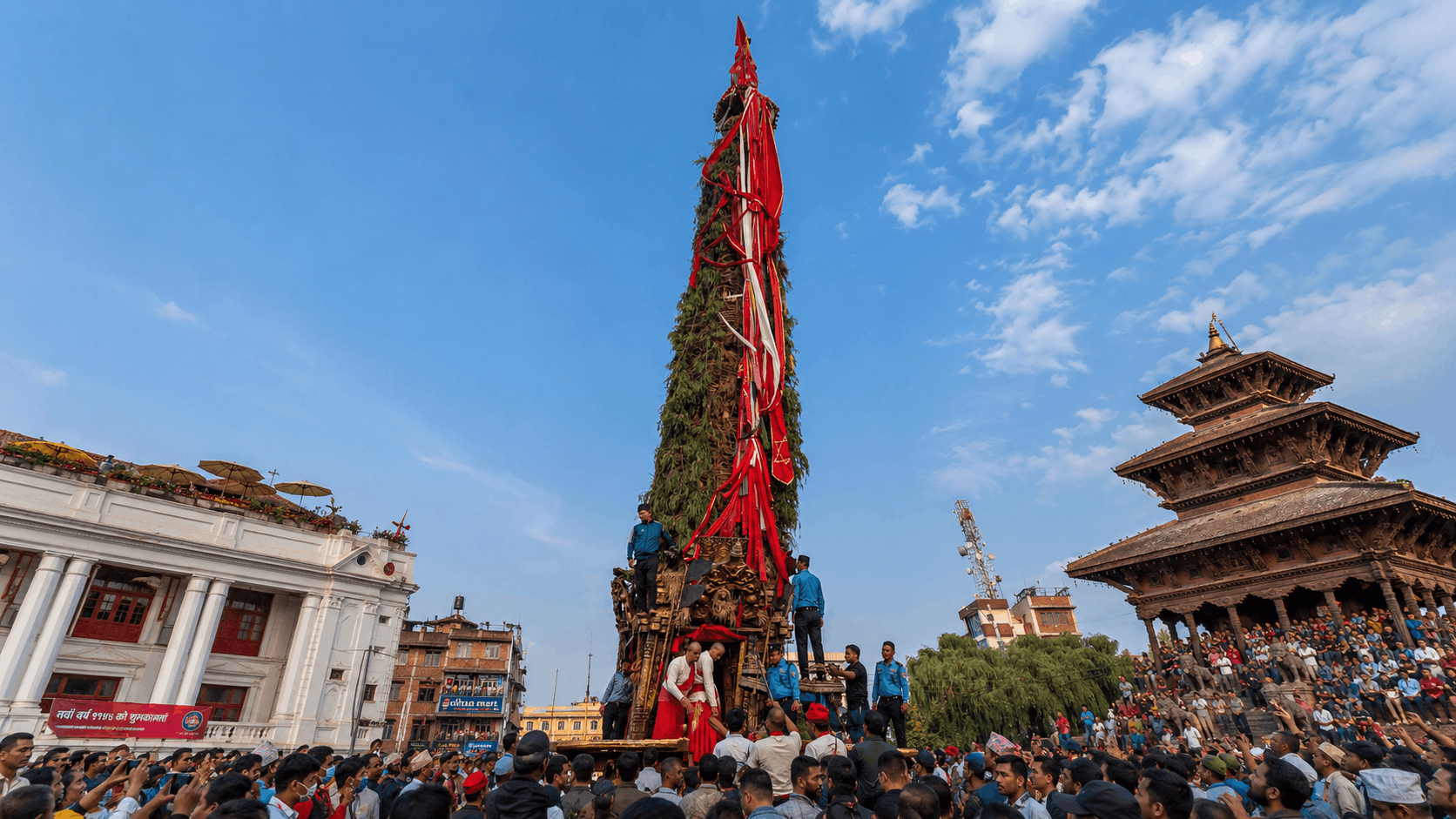
Bhoto Jatra is one of the most fascinating and unusual festivals celebrated in the Kathmandu Valley of Nepal, drawing hundreds of thousands of devotees, government officials, and curious travelers to Lalitpur every single year. Literally meaning the “Festival of the Vest,” Bhoto Jatra is the dramatic, crowd-pulling climax of the centuries-old Rato Machhindranath Jatra – one of the longest and oldest chariot festivals in the world. At its heart lies a 1,600-year-old legend of a stolen vest, an unresolved dispute, and a question asked aloud in public every year: “Whose vest is this?” In this guide, you’ll learn everything about Bhoto Jatra – its history, rituals, legends, and how to experience it for yourself.
A Complete Guide to Nepal’s Rato Machhindranath Jatra, Its History, Rituals, Legends, and Modern-Day Celebration in Lalitpur
Table of Contents
Introduction: What Is Bhoto Jatra?
The Origin and History of Rato Machhindranath Jatra
Rato Machhindranath Jatra: The Month-Long Chariot Procession
The Legend Behind Bhoto Jatra: The Mystery of the Stolen Vest
- The Serpent King’s Gift
- The Vest Goes Missing
- The Confrontation at the Festival
- The King’s Verdict and the Unanswered Question
The Bhoto Jatra Ceremony: How the Ritual Unfolds
- Choosing the Auspicious Date
- The Display of the Sacred Vest
- Who Attends Bhoto Jatra
- After the Display
The Special Twelve-Year Festival: Barha Barsa Jatra
Cultural and Religious Significance of Bhoto Jatra
- A Living Symbol of Hindu-Buddhist Harmony
- A Showcase of Newar Craftsmanship and Identity
- A Public Metaphor for Justice and Truth
- Economic and Tourism Importance
- A Living Tradition, Not a Historical Reenactment
A Visitor’s Guide to Experiencing Bhoto Jatra
Frequently Asked Questions About Bhoto Jatra
- What does “Bhoto Jatra” mean?
- Is Bhoto Jatra the same as Rato Machhindranath Jatra?
- Where is Bhoto Jatra celebrated?
- Why is a vest displayed during the festival?
- Who attends Bhoto Jatra?
- Is Rato Machhindranath a Hindu or Buddhist deity?
- How is the date of Bhoto Jatra decided each year?
- What is the Barha Barsa Jatra?
- Is Bhoto Jatra a public holiday in Nepal?
- Can tourists attend Bhoto Jatra?
Introduction: What Is Bhoto Jatra?
Bhoto Jatra, also written as Bhote Jatra or Bhotey Jatra, is one of the most fascinating and unusual festivals celebrated in the Kathmandu Valley of Nepal. The word “bhoto” refers to a traditional Nepali vest or waistcoat, while “jatra” means festival or procession. Put together, Bhoto Jatra translates literally to the “Festival of the Vest” or the “Vest-Showing Festival,” and it is also locally known as Bhoto Dekhaune Jatra.
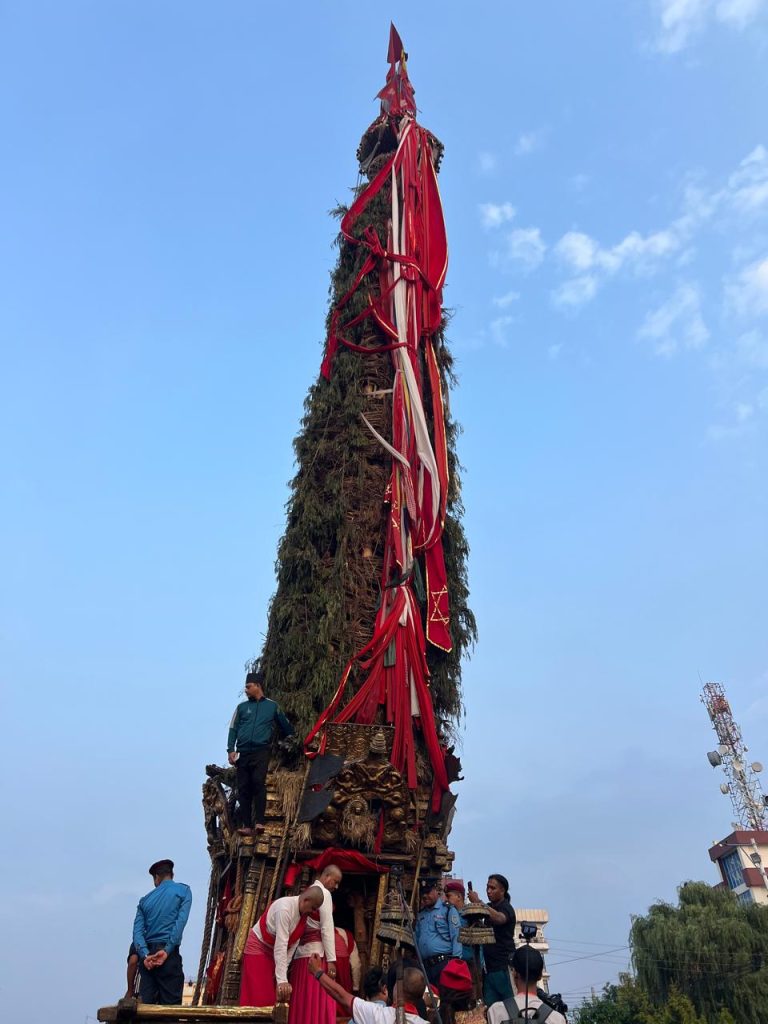
Bhoto Jatra is not a stand-alone festival. It is the dramatic, crowd-pulling finale of a much longer celebration called the Rato Machhindranath Jatra (also spelled Rato Machindranath Jatra), one of the oldest and longest chariot festivals in the world. The Rato Machhindranath Jatra unfolds over several weeks – sometimes close to two months – in Lalitpur (Patan), and it culminates with the dramatic public display of a jewel-studded black vest at Jawalakhel. This single ritual act, repeated faithfully for centuries, has turned Bhoto Jatra into one of Nepal’s most iconic living traditions and a major draw for cultural tourism in the Kathmandu Valley.
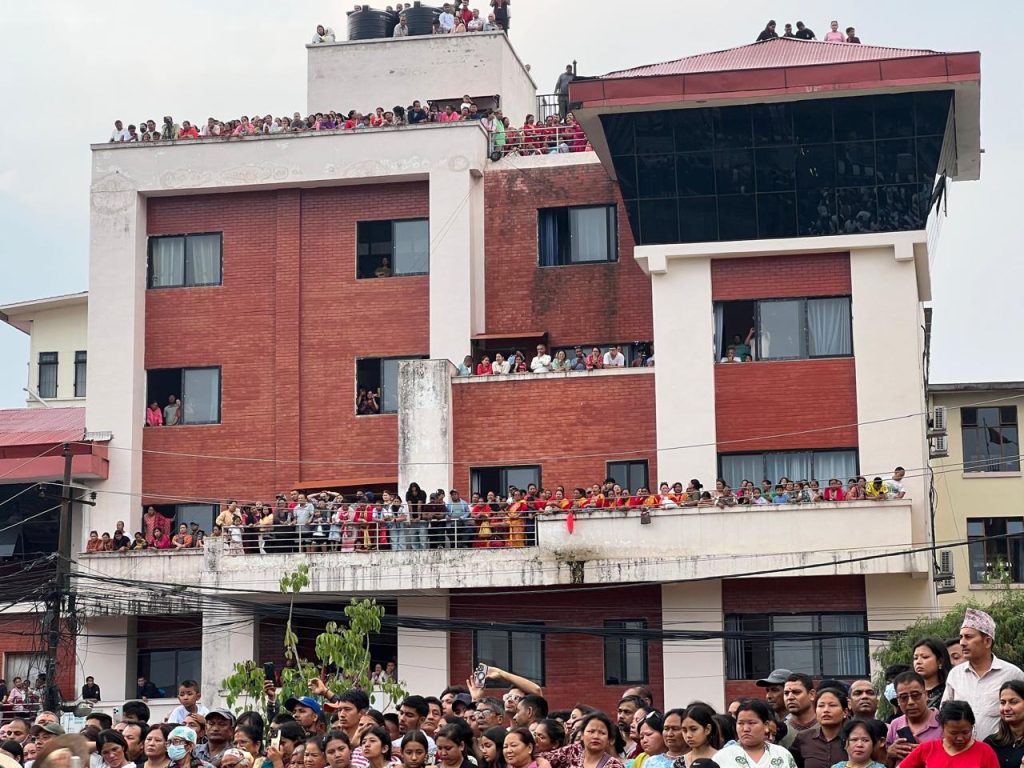
What makes Bhoto Jatra so compelling is not just its scale – with the President of Nepal, the Prime Minister, government officials, the Living Goddess Kumari of Patan, and hundreds of thousands of devotees and spectators in attendance – but the story behind it. At its heart lies a 1,600-year-old legend of a stolen vest, an unresolved dispute, and an open question that is asked aloud, in public, every single year: “Whose vest is this?” No one has ever stepped forward to claim it. That unanswered question is what keeps the tradition alive.
In this comprehensive guide, we cover everything you need to know about Bhoto Jatra and the Rato Machhindranath Jatra: their history and origin myths, the religious and cultural significance for both Hindus and Buddhists, the month-long chariot procession route through Lalitpur, the symbolism of the sacred vest, the role of the Kumari and the Nepali state, practical travel tips for visitors, and why this festival remains relevant in modern Nepal.
Bhoto Jatra at a Glance: Quick Facts
| Also Known As | Bhote Jatra, Bhotey Jatra, Bhoto Dekhaune Jatra (“Vest-Showing Festival”) |
| Part Of | Rato Machhindranath Jatra (Bunga Dyah Jatra) |
| Main Deity | Rato Machhindranath (Bunga Dyah / Karunamaya), god of rain and compassion |
| Location | Jawalakhel, Lalitpur (Patan), Kathmandu Valley, Nepal |
| Duration of Main Festival | Approximately one to two months (chariot construction to Bhoto display) |
| Calendar Used | Nepal Sambat / Bikram Sambat lunar calendar; exact dates fixed by astrologers |
| Typical Timing | Late April through June/July (Gregorian calendar) |
| Key Attendees | President of Nepal, Prime Minister, the Living Goddess Kumari of Patan, government officials |
| Community | Newar community of Lalitpur (Patan), with city-wide and valley-wide participation |
| Religious Significance | Sacred to both Hindus (as Matsyendranath) and Buddhists (as Avalokiteshvara/Karunamaya) |
| Public Holiday | Yes, observed as a public holiday in Lalitpur and the wider Kathmandu Valley |
Note: Because the Rato Machhindranath Jatra follows the lunar Nepal Sambat calendar, the exact dates of the chariot procession and Bhoto Jatra change every year and are confirmed only after astrological calculations closer to the event.
The Origin and History of Rato Machhindranath Jatra
To understand Bhoto Jatra, you first have to understand the much older festival it belongs to: the Rato Machhindranath Jatra, also called Bunga Dyah Jatra in Nepal Bhasa, the language of the Newar people. This chariot festival is widely regarded as one of the oldest continuously celebrated religious processions in the world, with roots tracing back roughly 1,600 years.
The Legend of the Great Drought
According to popular legend, the Kathmandu Valley once suffered a catastrophic twelve-year drought during the reign of King Gunakamadeva (also recorded as Gunakamdev), who ruled the valley between roughly 949 and 994 CE. Rivers dried up, crops failed, and the people of the valley faced famine and desperation. Seeking a solution, the king consulted tantric masters and astrologers, who advised that only a powerful rain deity could end the drought.
The deity in question was believed to reside far away in Kamarupa (in present-day Assam, India), worshipped there as a serpent-associated rain god. A mission was organized – in many versions of the legend involving the tantric master Bandhudatta and the Karkotaka serpent king – to bring this deity, in the form of a sandalwood idol, back to the Kathmandu Valley. When the deity arrived and was installed with proper rites, the drought broke and rain returned to the valley.
Other versions of the story credit King Narendra Deva, who reigned in the seventh century (roughly 640–683 CE), with establishing the chariot procession to mark the arrival of Bunga Dyah in Nepal and to celebrate the end of the devastating dry spell. Whichever king’s reign the story is anchored to, the underlying message is consistent: the deity arrived during a time of crisis, the rains returned, and the grateful people of the valley vowed to honor him every single year through a grand chariot procession.
Who Is Rato Machhindranath?
Rato Machhindranath, whose name literally means “Red Machhindranath” (a reference to the red color of the deity’s image), is one of the most theologically interesting figures in the religious landscape of the Kathmandu Valley because he is venerated simultaneously by two different religious traditions.
- To Hindus, he is identified with Matsyendranath, a revered yogic saint and an early master of Hatha Yoga and the Nath tradition.
- To Buddhists, particularly followers of Newar Vajrayana Buddhism, he is venerated as Karunamaya, a localized form of Avalokiteshvara, the Bodhisattva of Compassion.
- In Nepal Bhasa, he is also called Bunga Dyah, meaning the “deity of Bungamati,” the village where his temple stands and where the deity resides for half of the year.
This dual identity makes Rato Machhindranath – and by extension, the entire Bhoto Jatra and Rato Machhindranath Jatra tradition – a powerful living symbol of religious syncretism in Nepal. Hindus and Buddhists worship the same chariot, pull the same ropes, and gather at the same finishing line in Jawalakhel without contradiction. Few festivals anywhere in the world demonstrate this kind of seamless coexistence between two major religions as vividly as this one.
Rato Machhindranath is widely regarded as the deity of rain, agriculture, and good harvest. Farmers across the valley traditionally looked to the timing and success of his annual procession as an omen for the coming monsoon and the health of that year’s crops.
Rato Machhindranath Jatra: The Month-Long Chariot Procession
The Rato Machhindranath Jatra is not a single-day affair. It is a sprawling, multi-week (in some years nearly two-month) civic and religious undertaking that mobilizes thousands of people across Lalitpur. Bhoto Jatra is simply its final act – the climax that the entire valley waits for.
Building the Chariot
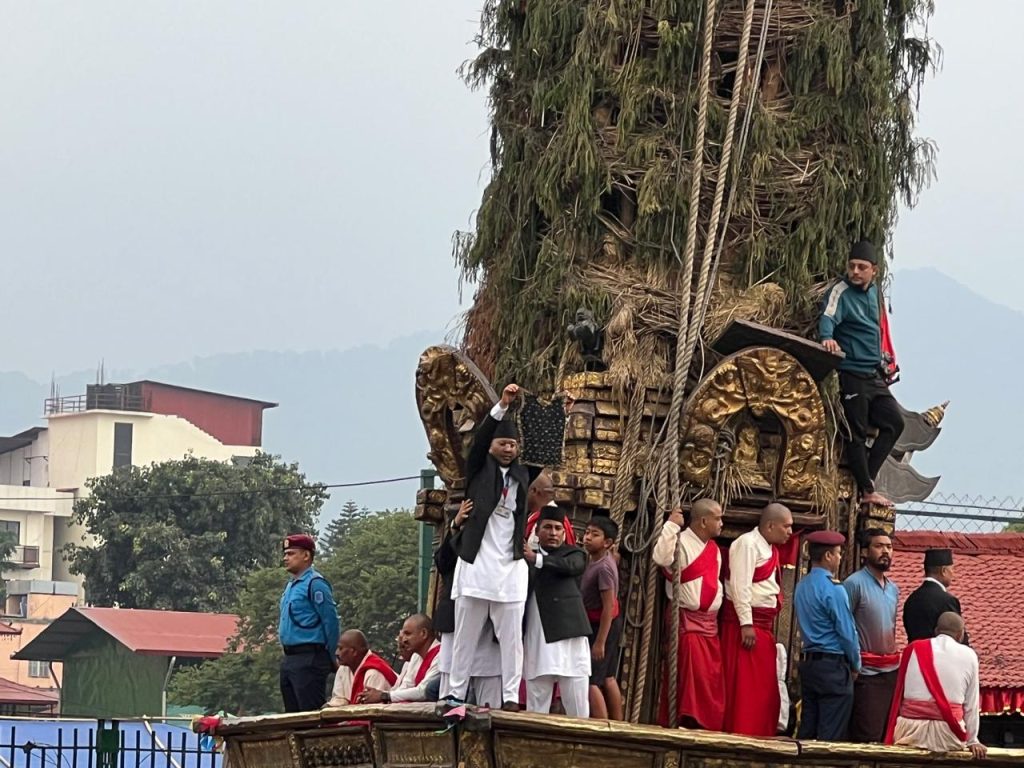
Preparations begin weeks in advance with the construction of an enormous wooden chariot, traditionally built without the use of nails, following techniques passed down for generations among Newar craftsmen. The chariot is assembled at Pulchowk, at the western edge of Lalitpur, using a tall wooden pole, layers of bamboo scaffolding, wheels carved from solid timber, and a canopy of branches (typically from specific sacred trees) tied together with rope and reinforced with metal bands at certain points.
The finished chariot towers an estimated 60 feet (about 18 meters) into the air, though the exact height varies slightly year to year depending on the materials gathered and the design followed by the Guthi (traditional trust or guild) responsible for the construction. Once complete, the sacred image of Rato Machhindranath is ceremonially transferred from his temple and installed at the heart of the chariot, alongside ritual offerings, garlands, and sacred cloths.
The main chariot is always accompanied by a second, smaller chariot dedicated to a companion deity, alternately referred to as Chakuwa Dyah or Minnath depending on the local tradition and source. The two chariots travel together for almost the entire route, reinforcing the festival’s emphasis on companionship and shared journey.
The Procession Route Through Lalitpur
Once built and loaded, the chariot is pulled by hand through the narrow medieval streets of Lalitpur over the course of several weeks, stopping at numerous traditional points along the way. While the precise sequence can vary slightly by year and by source, the procession broadly passes through these key locations:
- Pulchowk – starting point, where the chariot is constructed and first set in motion.
- Gabahal – an early stop in the heart of old Lalitpur.
- Mangal Bazaar – the historic square near Patan Durbar Square.
- Hakha and Sundhara – traditional neighborhoods along the historic route.
- Chakrabahil and Lagankhel – mid-route halting points where the chariot may rest for days at a time.
- Kumaripati – passed en route toward the final stretch.
- Jawalakhel – the final destination, where the chariot completes its journey and Bhoto Jatra is held.
As per long-held tradition, certain stretches of the route are reserved for specific groups of devotees. On the stretch between the localities known as Iti and Thati, the chariot is, by custom, pulled exclusively by men. On another notable day in the festival calendar known as Yakah Misaya Bhujya (literally, “the women’s chariot pulling” in Nepal Bhasa), the ropes are handed over entirely to women. From young girls to elderly grandmothers, women gather by the thousands to haul both the main Rato Machhindranath chariot and the smaller companion chariot along a defined stretch of the route, usually between Upper Lagankhel and Etii Tole.
By ensuring that the chariot physically cannot complete its journey without the labor of women, the festival enacts a public, communal acknowledgment of women’s indispensable role in sustaining both ritual life and agricultural survival – making it one of the more striking public expressions of women’s spiritual agency in South Asian religious practice.
Hazards Along the Way
The procession is not without risk. The towering, top-heavy wooden structure, pulled by hand over uneven cobbled streets and around tight medieval corners, occasionally tips, sways dangerously, or becomes stuck. Such incidents are taken extremely seriously by devotees, who interpret them as signs requiring immediate ritual remedy – special prayers, additional offerings, or purification rites – before the procession is allowed to continue. Despite these occasional setbacks, the procession has continued, in some form, almost without interruption for sixteen centuries.
The Legend Behind Bhoto Jatra: The Mystery of the Stolen Vest
The story behind the sacred vest itself is the emotional core of the entire festival, and it is told and retold across the Kathmandu Valley with slight regional variations. While the details differ from version to version, the essential structure of the legend remains remarkably consistent.
The Serpent King’s Gift
Long ago, the serpent king Karkotaka Naga (also written Karkotak Nagaraj) faced a personal crisis: his wife had fallen seriously ill, and in some tellings the affliction specifically affected her eyes. Desperate to find a cure, Karkotaka assumed human form and traveled through the Kathmandu Valley in search of help.
During his search, he came across a Jyapu, a Newar farmer, working in his fields. In one widely told version of the story, Karkotaka, still disguised as a traveler, asked the farmer directly whether he was capable of curing illness. Caught off guard and flustered, the farmer blurted out “yes” without fully understanding what he was agreeing to. Karkotaka then revealed his true identity and insisted that the farmer accompany him to treat his ailing wife.
Despite his fear and uncertainty, the farmer went along. Using his practical knowledge of ayurvedic herbs and natural remedies – the everyday medicinal wisdom common among Newar farming communities – he managed to treat and heal Karkotaka’s wife. In gratitude for this service, the serpent king rewarded the farmer with a precious gift: a black vest (bhoto) studded with jewels and gemstones, said to be of extraordinary, almost magical value.
The Vest Goes Missing
The farmer treasured his new vest, but disaster struck while he was out working in the fields. According to the most common version of the legend, the farmer took off the bhoto while plowing or laboring under the sun, setting it aside momentarily. A mischievous spirit or demon-like figure known as a Lakhe (a masked, supernatural character recognized throughout Newar festival culture) spotted the unattended vest and stole it, vanishing before the farmer could stop him.
The farmer searched everywhere for his prized possession but came home empty-handed and deeply disheartened. Time passed, and the loss seemed permanent – until fate intervened.
The Confrontation at the Festival
Sometime later, the farmer attended the Rato Machhindranath Jatra in Jawalakhel along with the rest of the valley’s residents. By extraordinary coincidence, he spotted the very same Lakhe who had stolen his bhoto, now wearing it openly amid the festival crowd. Enraged, the farmer confronted the spirit and demanded the return of his property.
The Lakhe refused, insisting the vest was rightfully his own. A heated dispute broke out in full view of the gathered crowd, and the disagreement escalated until it was brought before the king himself for judgment. The king listened carefully to both sides, but neither the farmer nor the Lakhe could produce definitive, irrefutable proof of ownership. The case could not be resolved through ordinary means.
The King’s Verdict and the Unanswered Question
Faced with an impasse, the king – in most versions identified as Gunakamadeva – issued a wise and lasting decree: rather than awarding the bhoto to either claimant, the vest would be placed in the safekeeping of Rato Machhindranath himself, held by the deity’s priests until either party could return with conclusive evidence of ownership. Both the farmer and the Lakhe agreed to this arrangement and departed, with the understanding that they would return the following day with stronger proof.
Neither of them ever came back. The next day, at the appointed time, the bhoto was held aloft from the Machhindranath chariot and displayed in all four cardinal directions for the gathered public to see, in case the rightful owner – or anyone able to vouch for either claimant – might step forward. No one did.
From that day onward, the display of the bhoto became a permanent annual ritual: an open, public invitation for the true owner to come forward and reclaim what is rightfully theirs. According to belief still held by many devotees today, Karkotaka Naga himself is present at the festival every year, silently watching the proceedings, since the bhoto originally belonged to him before it passed through the farmer and the Lakhe. Yet to this day, across sixteen centuries of repetition, no one has ever stepped forward to make that claim.
“Yo bhoto kasko ho?” – “Whose vest is this?” The question is called out three times from the top of the chariot. Every single year, the answer is silence.
The Bhoto Jatra Ceremony: How the Ritual Unfolds
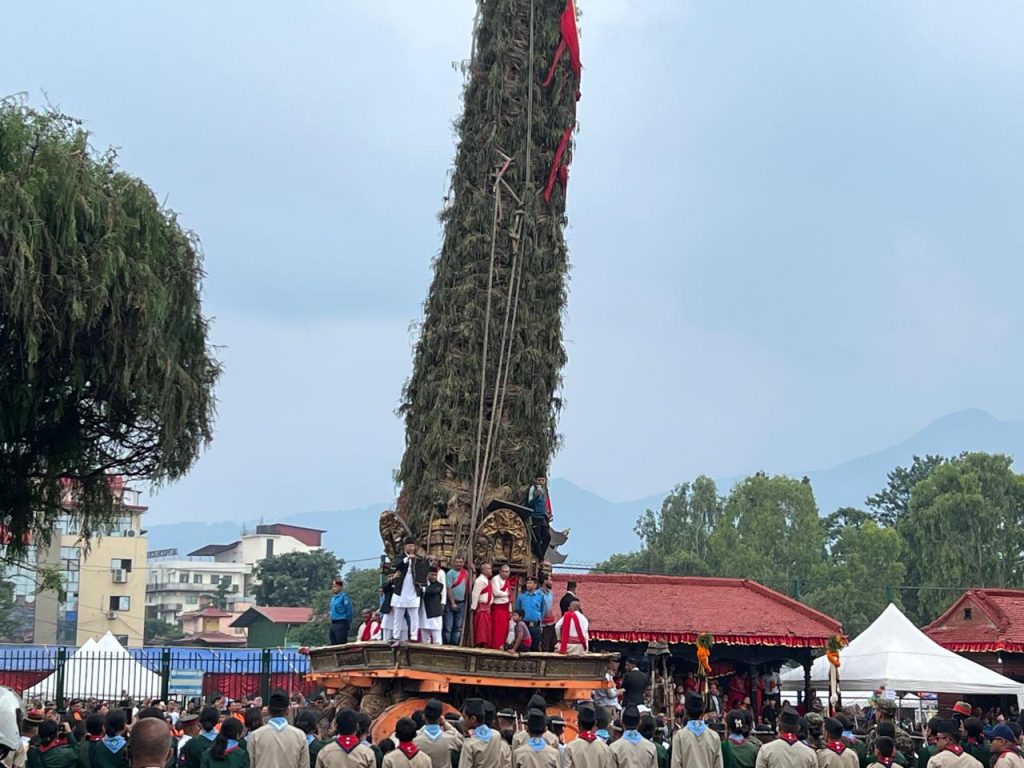
After weeks of procession through the streets of Lalitpur, the chariot of Rato Machhindranath – along with its smaller companion chariot – finally reaches the open grounds of Jawalakhel, on the western side of the city. This is where the festival reaches its climax.
Choosing the Auspicious Date
The exact date of Bhoto Jatra is never fixed in advance on the Gregorian calendar. Once the chariot arrives at Jawalakhel, astrologers are consulted to identify the most auspicious day for the vest-showing ceremony, typically within a few days of the chariot’s arrival. As a result, the festival’s date shifts from year to year, generally falling somewhere between late May and early June, though in some years it has occurred as late as August, depending entirely on the lunar Nepal Sambat calendar and astrological calculations.
The Display of the Sacred Vest
On the appointed day, an official representative – traditionally a member of the Guthi (the hereditary trust responsible for managing the deity’s rituals and properties) – climbs to the very top of the towering chariot. There, in front of the assembled crowd, the jewel-studded black bhoto is lifted into the air and shown, in turn, toward all four cardinal directions: north, south, east, and west, so that everyone gathered around the chariot has the opportunity to see it clearly.
As the vest is displayed in each direction, the question is called out aloud: “Whose vest is this?” This act is performed with full ceremonial seriousness, even though everyone present already knows from centuries of tradition that no claimant will ever appear. The repetition itself – the act of asking, in public, year after year – is what gives the ritual its enduring power.
Who Attends Bhoto Jatra
Bhoto Jatra is attended by an extraordinary cross-section of Nepali society, reflecting just how deeply woven into national life this festival has become:
- The President of Nepal, who traditionally attends in person as the ceremonial Head of State.
- The Prime Minister and other senior government officials and dignitaries.
- The Living Goddess Kumari of Patan, who travels to Jawalakhel and observes the ceremony from a specially designated rest house, adding a profound layer of sacred presence to the event.
- Guthi officials and priests responsible for the rituals associated with Rato Machhindranath.
- Tens of thousands of local devotees from across the Kathmandu Valley, as well as a growing number of domestic and international tourists.
The presence of the President of Nepal at this Newar religious ceremony is itself significant: it represents a continuation of a much older tradition in which the Malla and later Shah kings of the Kathmandu Valley personally attended and legitimized the festival through their presence. Even after Nepal’s transition from monarchy to republic, the state’s symbolic participation in Bhoto Jatra has remained unbroken, underscoring just how central this ritual is to Nepali civic and cultural identity.
After the Display
Once the vest has been shown in all four directions and the ceremonial question has gone unanswered for another year, the bhoto is returned to the safekeeping of the temple authorities. Shortly after, the towering chariot is carefully dismantled, piece by piece, and its components are stored away until preparations begin again for the following year’s festival.
The sacred image of Rato Machhindranath is then carried, typically on a palanquin, to the nearby village of Bungamati, sometimes referred to as the deity’s “first home” and closely associated with the rain god’s origins in valley mythology. There, the deity resides for roughly six months before the entire cycle begins again with preparations for the next year’s procession.
The Special Twelve-Year Festival: Barha Barsa Jatra
While Bhoto Jatra and the Rato Machhindranath Jatra are celebrated every single year, there is a far grander version of the festival that occurs only once every twelve years, known as the Barha Barsa Jatra.
During this rare occurrence, the entire chariot is constructed not at Pulchowk in Lalitpur, but at Bungamati, the village where Rato Machhindranath spends half of each year. From there, the immense chariot is pulled across a much longer and more arduous route, passing through Bhaisepati, Nakkhu, Bhanimandal, and Jhamsikhel before finally reaching Pulchowk.
One particularly dramatic stretch of this route – from Jhamsikhel (near Ideal Model School) to Pulchowk – is traditionally completed at night, adding an atmospheric and almost mystical quality to an already extraordinary undertaking. Once the chariot reaches Pulchowk, it rejoins the normal annual route through the city toward Jawalakhel, where Bhoto Jatra is held as usual.
Because the Barha Barsa Jatra happens so infrequently, it attracts even larger crowds than the standard annual festival and is regarded by many Newar elders and cultural historians as the truest, most complete expression of the original Bunga Dyah tradition.
Cultural and Religious Significance of Bhoto Jatra
A Living Symbol of Hindu-Buddhist Harmony
Perhaps the single most important aspect of Bhoto Jatra and the wider Rato Machhindranath Jatra is what it represents for religious coexistence in Nepal. Few places in the world can point to a single deity, a single chariot, and a single festival that is simultaneously and sincerely venerated by two of the world’s major religious traditions without conflict or contradiction. Hindus worship Rato Machhindranath as Matsyendranath, a legendary yogic master; Buddhists worship the very same deity as Karunamaya, an emanation of Avalokiteshvara. Both communities pull the same ropes, sing the same devotional songs, and gather at the same finish line.
A Showcase of Newar Craftsmanship and Identity
Beyond its religious dimension, Bhoto Jatra is a profound celebration of Newar cultural identity and craftsmanship. The construction of a 60-foot wooden chariot without a single nail, using techniques handed down across generations, is itself a remarkable feat of traditional engineering. The intricate woodcarving, the elaborate costumes worn by participants, the rhythmic music of traditional instruments, and the colorful masked dances that accompany the procession all reflect centuries of accumulated artistic and cultural knowledge unique to the Newar community of the Kathmandu Valley.
A Public Metaphor for Justice and Truth
The unresolved dispute over the bhoto carries a meaning that extends well beyond religious ritual. Many observers and scholars interpret the annual display of the vest as a powerful public metaphor for justice, evidence, and the rule of law: a reminder that claims must be backed by proof, and that even unresolved disputes can be handled with patience, transparency, and fairness rather than force. The ritual act of asking “Whose vest is this?” in front of the Head of State, year after year, symbolically affirms that even the highest authorities in the land submit to a process of open inquiry rather than arbitrary decree.
Economic and Tourism Importance
In the modern era, Bhoto Jatra and the Rato Machhindranath Jatra have also become economically significant events for Lalitpur and the wider Kathmandu Valley. The extended festival period boosts local trade considerably: vendors sell traditional foods, handicrafts, and religious artifacts throughout the procession route, while hotels, restaurants, and transportation services see a noticeable rise in demand from domestic and international visitors. The festival also provides seasonal employment and recognition for artisans, woodcarvers, mask-makers, and musicians who contribute their skills to the chariot’s construction and the surrounding cultural performances.
A Living Tradition, Not a Historical Reenactment
It is worth emphasizing that Bhoto Jatra is not a staged historical reenactment performed for tourists. It is a living, evolving ritual carried out with full religious seriousness by the people who actually believe in its meaning. The festival has occasionally collided with modern political and administrative realities – including, in at least one documented instance, a tense standoff between devotees and state authorities that required the intervention of a special forgiveness ritual (kshama puja) before the procession could safely continue. Such episodes only reinforce how much cultural weight this tradition carries in contemporary Nepali society.
A Visitor’s Guide to Experiencing Bhoto Jatra
When to Go
Because the date of Bhoto Jatra is determined by astrological calculation each year, travelers planning to attend should confirm the exact date as close to the event as possible, ideally by checking with the Nepal Tourism Board, local Lalitpur authorities, or recent local news coverage in the weeks leading up to the festival. As a general pattern, the chariot procession tends to begin in mid-to-late April, with Bhoto Jatra itself usually falling sometime between late May and late June, though variation from year to year is normal and expected.
Where to Watch
Jawalakhel, on the western edge of Lalitpur, is the single best location to witness the climactic vest-showing ceremony. The open ground there accommodates the enormous crowds that gather for the event, although arriving early is strongly advised given the scale of attendance, the presence of high-level security for dignitaries, and the popularity of good vantage points near the chariot.
For visitors who want a deeper, more immersive experience of the festival, it is well worth spending time along the procession route in the weeks beforehand. Locations such as Patan Durbar Square, Mangal Bazaar, and Gabahal offer a chance to see the chariot up close as it pauses or moves slowly through the historic streets, away from the largest Jawalakhel crowds.
Practical Tips
- Dates change every year – always reconfirm the schedule shortly before traveling, since both the procession and the Bhoto Jatra date depend on lunar and astrological calculations.
- Expect very large crowds at Jawalakhel on the day of the vest display, especially given the attendance of the President, Prime Minister, and other officials.
- Dress modestly and respectfully, as this is an active religious ceremony, not a staged performance.
- Photography is generally welcomed, but be mindful and respectful around active rituals, priests, and the Kumari’s rest house.
- Patan Durbar Square, a UNESCO World Heritage Site, is within walking distance of much of the procession route and is well worth visiting before or after the festival.
- Local guides and cultural tours are widely available in Lalitpur and can provide valuable context on the legends, rituals, and etiquette associated with the festival.
- Public transportation and roads around Lalitpur can be heavily congested during the festival period; allow extra travel time.
Respectful Participation
Visitors are generally welcome to observe Bhoto Jatra, and the festival’s organizers and the wider Newar community have long taken pride in sharing this tradition with the world. That said, it remains, first and foremost, a sacred religious ceremony for the people of the Kathmandu Valley. Approaching the festival with curiosity, patience, and respect – rather than treating it purely as a photo opportunity – will make for a far more meaningful experience.
Frequently Asked Questions About Bhoto Jatra
What does “Bhoto Jatra” mean?
“Bhoto” means vest or waistcoat in Nepali, and “jatra” means festival or procession. Together, Bhoto Jatra means “Vest Festival” or “Festival of the Vest.” It is also called Bhoto Dekhaune Jatra, meaning “the vest-showing festival.”
Is Bhoto Jatra the same as Rato Machhindranath Jatra?
Not exactly. Rato Machhindranath Jatra is the full month-long (sometimes nearly two-month) chariot festival honoring the deity Rato Machhindranath. Bhoto Jatra is the final, climactic ceremony of that larger festival, held at Jawalakhel once the chariot completes its journey through Lalitpur.
Where is Bhoto Jatra celebrated?
Bhoto Jatra is celebrated at Jawalakhel, on the western side of Lalitpur (Patan), in the Kathmandu Valley of Nepal. The broader Rato Machhindranath Jatra procession passes through numerous neighborhoods of Lalitpur before arriving there.
Why is a vest displayed during the festival?
The display re-enacts a centuries-old legend in which a farmer received a jewel-studded vest as a gift from the serpent king Karkotaka Naga, only for it to be stolen by a Lakhe (a spirit figure). The resulting ownership dispute was never resolved, so the vest is shown publicly every year as an open invitation for the rightful owner to step forward and claim it.
Who attends Bhoto Jatra?
The festival is attended by the President of Nepal, the Prime Minister, senior government officials, the Living Goddess Kumari of Patan, Guthi officials and priests, and tens of thousands of devotees and visitors from across Nepal and abroad.
Is Rato Machhindranath a Hindu or Buddhist deity?
Both. Rato Machhindranath is venerated by Hindus as Matsyendranath, a revered yogic saint, and by Buddhists as Karunamaya, a localized form of the Bodhisattva Avalokiteshvara. This dual veneration makes the festival a powerful symbol of religious harmony in Nepal.
How is the date of Bhoto Jatra decided each year?
The date is determined by astrologers based on the lunar Nepal Sambat and Bikram Sambat calendars, generally fixed for a few days after the Rato Machhindranath chariot arrives at Jawalakhel. Because of this, the Gregorian calendar date changes every year.
What is the Barha Barsa Jatra?
The Barha Barsa Jatra is a special, much larger version of the festival held once every twelve years, in which the chariot is built at Bungamati village rather than Pulchowk and pulled along a longer route before rejoining the normal path to Jawalakhel.
Is Bhoto Jatra a public holiday in Nepal?
Yes, Bhoto Jatra is observed as a public holiday in Lalitpur and across much of the Kathmandu Valley, reflecting its importance to the local community and the broader region.
Can tourists attend Bhoto Jatra?
Yes, tourists are welcome to observe the festival. Jawalakhel is the best location to witness the main vest-showing ceremony, though visitors should expect very large crowds and should dress and behave respectfully, as it remains an active religious event.
Conclusion: Why Bhoto Jatra Still Matters
Bhoto Jatra endures not because it offers a tidy resolution, but precisely because it doesn’t. For sixteen centuries, the people of the Kathmandu Valley have gathered at Jawalakhel to ask the same question into the open air – “Whose vest is this?” – and for sixteen centuries, the answer has been silence. That silence is the festival’s quiet power. It keeps alive a story about kindness repaid, justice deferred, and patience rewarded not with an ending, but with the dignity of an honest, unresolved question asked again and again, in good faith, before the whole community.
Today, Bhoto Jatra stands as far more than a religious curiosity. It is a vivid, living demonstration of how Hinduism and Buddhism can share a single sacred object and a single sacred chariot without friction; a showcase of extraordinary Newar craftsmanship passed down without interruption across generations; a moment when the highest officials of the Nepali state stand shoulder to shoulder with ordinary devotees; and a celebration that continues to draw visitors from around the world into the heart of Lalitpur’s ancient streets.
Whether you are a devotee following a centuries-old family tradition, a curious traveler witnessing the spectacle for the first time, or simply someone reading about it from afar, Bhoto Jatra offers a rare window into a festival where myth, faith, craftsmanship, and modern statecraft all meet – once a year, in a single jewel-studded vest, held up against the sky.
This article synthesizes historical accounts, religious tradition, and cultural research on Bhoto Jatra and the Rato Machhindranath Jatra as documented by Nepali cultural and tourism sources. Festival dates and specific details may be updated annually by local authorities and astrologers; readers planning to attend should verify current-year dates closer to the event.


