
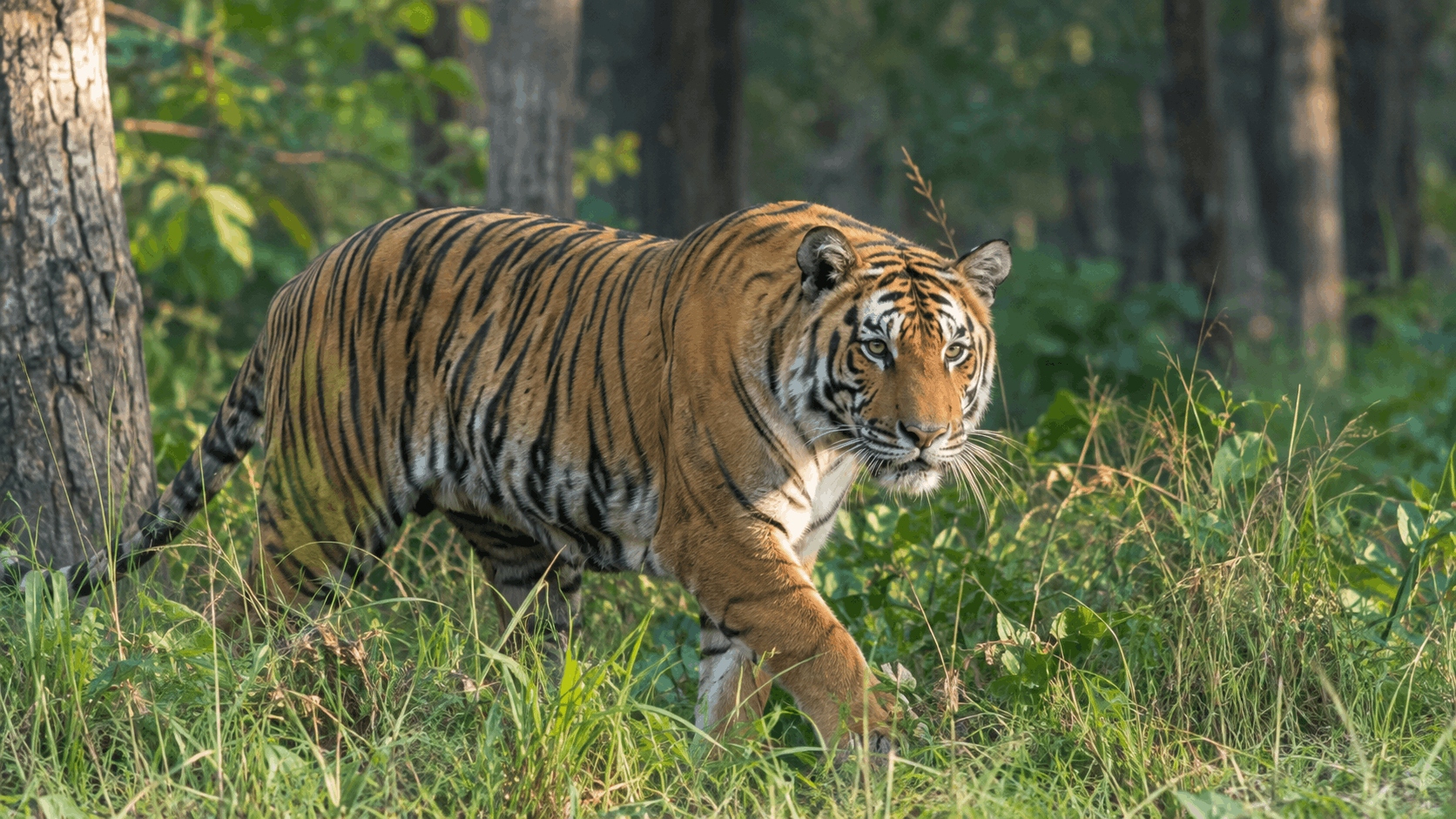
Nepal is planning to establish a 50-hectare tiger sanctuary in Chitwan to provide a more natural and secure environment for problem tigers that cannot safely be released back into the wild.
The proposed sanctuary will be constructed at Devnagar in the buffer zone of Chitwan National Park, one of Nepal’s most important tiger habitats. The facility is expected to accommodate up to 20 tigers and could also become a new attraction for wildlife tourism in the region.
The Government of Nepal has allocated Rs 5 crore in the current fiscal year to initiate construction of the sanctuary.
According to Haribhadhra Acharya, spokesperson for the Department of National Parks and Wildlife Conservation, the project will be developed in phases and is intended to improve the management of tigers that pose a threat to people, livestock, property or other wildlife.
Where will Nepal’s new tiger sanctuary be built?
The proposed tiger sanctuary will be located in Devnagar, Chitwan, within the buffer zone of Chitwan National Park.
Two problem tigers are currently being kept at the site, which already has a holding facility. The proposed development will expand the area into a much larger sanctuary designed to provide tigers with more space and a setting closer to their natural habitat.
The sanctuary is planned to cover approximately 50 hectares and will eventually have the capacity to hold as many as 20 tigers.
The location is particularly significant because Chitwan is one of Nepal’s major tiger conservation landscapes and already supports a large population of wild Bengal tigers.
What will the Chitwan tiger sanctuary include?
The proposed facility will combine tiger enclosures, visitor infrastructure and safety measures.
According to officials, the sanctuary will include:
- Separate enclosures for individual problem tigers
- Forested areas within the enclosures
- Two-layer barriers to prevent tiger escapes
- Electric fencing
- Water ponds for the animals
- Viewing towers for visitors
- A “close bridge” for observing tigers
- Vehicle-based viewing areas inside an open enclosure
- The existing tiger holding centre
The design will focus on maintaining a safe physical separation between visitors and tigers.
Acharya said the structures would be designed so that people remain within protected areas while the tigers remain outside those areas.
This approach is intended to allow visitors to observe the animals without compromising public safety or animal welfare.
How will the tiger sanctuary be developed?
The project is expected to be implemented in three phases.
The first phase will focus on beginning construction and establishing the basic infrastructure required to safely manage the tigers. Subsequent phases are expected to expand the sanctuary’s enclosures and visitor facilities.
The proposed development will include designated areas for individual tigers, limited forest space, electric fencing, viewing structures and water sources.
Officials acknowledge that the complete project will require significantly more investment than the initial allocation.
The government has therefore allocated Rs 5 crore during the current fiscal year to start construction, while additional funding will be required as the project progresses.
Why does Nepal need a tiger sanctuary?
Nepal has been successful in increasing its tiger population over the past decade. However, the growth in tiger numbers has also increased the need for effective management of individual animals that repeatedly come into conflict with people.
Some tigers enter human settlements, attack livestock or cause injuries and deaths. When such animals are captured, authorities must decide whether they can safely be returned to the wild or need to remain in captivity.
These animals are commonly referred to as problem tigers.
Some captured tigers can eventually be released into suitable forest habitats after assessment. Others are considered too dangerous to return to the wild and may have to remain in enclosures for the rest of their lives.
A dedicated sanctuary could therefore provide Nepal with an alternative to keeping such animals in relatively limited conventional enclosures.
Nepal currently has 19 problem tigers in enclosures
Nepal currently has 19 problem tigers being kept in enclosures across the country, according to conservation officials.
Their distribution is:
| Location | Problem Tigers |
|---|---|
| Chitwan | 7 |
| Bardiya | 5 |
| Central Zoo | 5 |
| Parsa | 1 |
| Banke | 1 |
| Total | 19 |
Chitwan currently houses seven problem tigers.
However, limited space has already become an issue. A tiger captured earlier this month was sent to Parsa because Chitwan did not have sufficient space to accommodate another animal.
The proposed 50-hectare sanctuary is intended to address this growing management challenge.
What is a “problem tiger”?
A problem tiger is generally an individual that repeatedly enters areas used by people and poses a serious threat to human life, livestock or property.
Not every tiger that enters a human settlement is necessarily permanently classified as a problem animal. Conservation authorities assess individual cases based on the animal’s behaviour, circumstances and potential risk.
Some tigers may be captured temporarily and later released into the wild.
Others may be considered unsuitable for release because of repeated attacks or other behaviour that presents an unacceptable risk to nearby communities.
Experts estimate that approximately 5 percent of tigers naturally become problem animals.
As Nepal’s tiger population grows, authorities are consequently facing a greater need for facilities where high-risk animals can be safely managed.
Chitwan remains one of Nepal’s major tiger habitats
The proposed sanctuary is being planned in Chitwan at a time when Nepal’s wild tiger population has increased substantially.
Nepal’s latest national tiger survey recorded 429 tigers, compared with 355 in 2022 and only 121 in 2010.
The latest population figures by national park are:
| National Park | Tiger Population |
|---|---|
| Chitwan | 145 |
| Bardiya | 112 |
| Parsa | 71 |
| Banke | 51 |
| Shuklaphanta | 50 |
| Nepal Total | 429 |
With an estimated 145 tigers, Chitwan has the largest tiger population among Nepal’s national parks.
The figures demonstrate the country’s progress in tiger conservation, but they also highlight the need for stronger systems to manage human-wildlife conflict.
Could the sanctuary become a new tourism attraction?
The proposed facility could also create a new opportunity for wildlife tourism in Chitwan.
Chitwan is already one of Nepal’s best-known wildlife tourism destinations, attracting domestic and international visitors interested in jungle safaris, rhinoceros, elephants, crocodiles, birds and Bengal tigers.
The proposed sanctuary’s viewing towers, close bridge and vehicle-based viewing facilities could allow visitors to observe problem tigers in a controlled environment.
However, the primary purpose of the project will remain wildlife management, conservation and public safety, rather than tourism alone.
If appropriately designed and managed, the sanctuary could combine conservation education with responsible wildlife viewing.
A new approach to managing human-tiger conflict
Nepal’s increasing tiger population is an important conservation achievement, but it also creates new challenges.
More tigers can mean greater competition for territory and resources, particularly in areas where protected forests are surrounded by settlements, farms and other human activities.
The management of problem tigers is therefore becoming an increasingly important part of Nepal’s conservation strategy.
The proposed Chitwan sanctuary could provide authorities with a dedicated location to house animals that cannot be safely released while giving them considerably more space than traditional zoo-style facilities.
For Chitwan, the project could eventually serve three purposes: problem-tiger management, conservation education and controlled wildlife tourism.
Nepal’s tiger conservation success comes with new challenges
Nepal has made significant progress in tiger conservation since 2010, when the national tiger population stood at just 121.
The population has now reached 429, placing Nepal among the countries that have made substantial progress toward global tiger conservation goals.
But increasing populations also require stronger habitat management, monitoring, conflict mitigation and long-term facilities for animals that cannot return to the wild.
The proposed 50-hectare Chitwan tiger sanctuary is one response to that challenge.
With construction expected to begin this fiscal year using the initial Rs 5 crore government allocation, the project could eventually become an important part of Nepal’s strategy for managing problem tigers while supporting the country’s broader wildlife conservation and tourism objectives.
Frequently Asked Questions
What is Nepal planning in Chitwan?
Nepal is planning a 50-hectare tiger sanctuary at Devnagar in the buffer zone of Chitwan National Park to house and manage problem tigers in a more natural environment.
How many tigers will the new Chitwan sanctuary accommodate?
The proposed sanctuary is expected to accommodate up to 20 tigers.
How much money has the government allocated for the project?
The Government of Nepal has allocated Rs 5 crore in the current fiscal year to begin construction.
How many problem tigers are currently kept in Nepal?
There are currently 19 problem tigers in enclosures across Nepal. Seven are in Chitwan, five in Bardiya, five at the Central Zoo, one in Parsa and one in Banke.
How many tigers are there in Chitwan National Park?
Nepal’s latest national tiger survey recorded approximately 145 tigers in Chitwan.
How many tigers are there in Nepal?
The latest national tiger survey recorded 429 tigers across Nepal, up from 355 in 2022 and 121 in 2010.
Why are some tigers kept in enclosures?
Some tigers are captured because they repeatedly pose a serious threat to people, livestock or property. While some can eventually be released, others may be considered unsuitable for release and require permanent care.
Will tourists be able to see the tigers?
The proposed sanctuary is expected to include viewing towers, a “close bridge” and vehicle-based viewing facilities. These would allow visitors to observe the animals while maintaining safety barriers.
When will construction begin?
The government has allocated Rs 5 crore for the current fiscal year, with construction expected to begin during the fiscal year. The entire project will be developed in three phases and will require additional investment.


